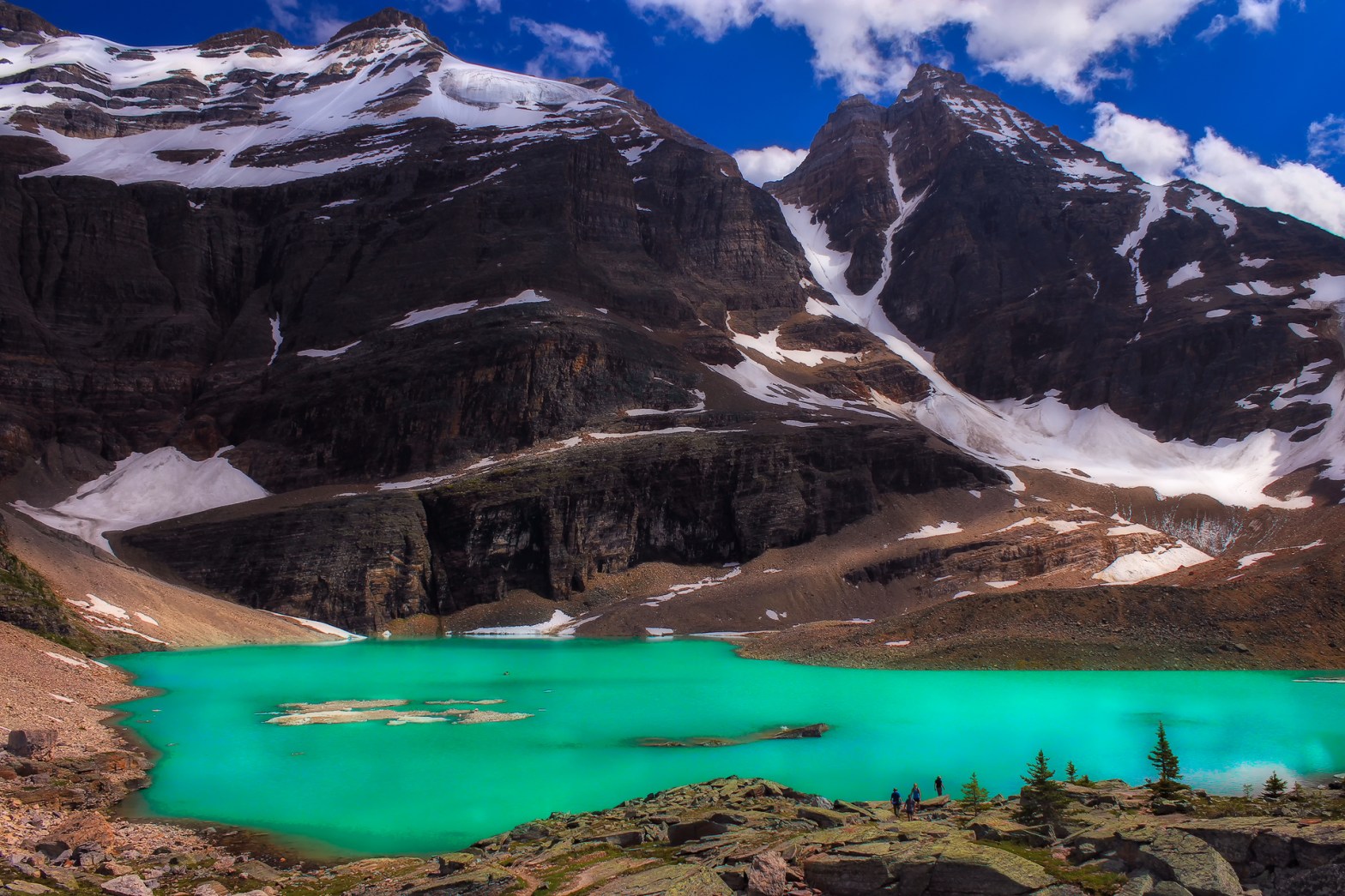
On a cold, cloudy, and blustery spring day, bright fishing shacks and fresh foliage add some welcome color to the landscape. Prince Edward Island, Canada. Prints Available.
Photo of the Week
On the final evening of an unforgettable week exploring Arches National Park and the greater Moab area, my dad and I took one last ride into the park for sunset. Having driven every inch of the park road several times over in the previous days, I was beginning to think that I had already learned all the secrets that Arches had to reveal. As we nonchalantly cruised through the park with the breeze in our hair and sun on our skin, I was more focused on enjoying a final joyride in the Mustang convertible that had been our trusty steed all week than finding something new to photograph. I was quickly reminded, though, that in places as magical as Arches, there’s always more to discover, and that 100 lifetimes would never be enough to truly see and appreciate all that Arches has to offer. As we motored down the road, a line of vibrant, freshly bloomed cottonwood trees that I somehow hadn’t noticed before caught my eye, and I decided to pull over to check things out. Once I stepped out of the car and surveyed the scene, though, it wasn’t the cottonwoods that grabbed my attention. It was the clutch of yellow wildflowers – the first such flowers we had seen all week – just off the road that held my gaze. I was so giddy about the flowers that at first, I didn’t even notice that right in front of the flowers was a group of prickly pear cactus. Wildflowers, cacti, lush spring cottonwoods, sandstone towers, and a gorgeous sunset? Talk about saving the best for last! As my dad and I savored the moment while my camera clicked away, we talked about how serendipitous this parting gift from Arches was. As we chatted and savored a final sunset in our new favorite place, I began to wonder – what other yet to be discovered treasures are out there tucked between the arches and buttes? We’ll just have to go back to find out. Prints Available.
Photo of the Week
A yellow warbler takes a breather in a flowering tree on a spring day in Prince Edward Island. Prints Available.
Altered Mind State
This article along with others can be found at Pure Adirondacks.
Photography Equipment: Canon 6D, Canon EF 16-35mm f/4L IS USM Lens, Gitzo mountaineer tripod, Really Right Stuff ballhead, remote shutter release, B+W 6-stop neutral density filter, B+W circular polarizer
Exposure Data:
Exposure 1 (waterfall and foreground): 15 sec. at f/11, ISO 100, 21 mm
Exposure 2 (background): 0.3 sec. at f/11, ISO 100, 21 mm
Anyone that’s ever trekked along the Lake Road from the Ausable Club near Keene Valley knows that this gateway to the High Peaks is equal parts a blessing and a curse. While it can be a quick and easy way to cover ground en route to popular peaks such as Gothics or Indian Head, in the heat of summer it can also be a dusty, sweltering, and altogether boring jaunt, as it was for me on the day that this photo was taken. I was thrilled to finally reach the Gill Brook Trail and trade the noise and dust clouds of the Ausable Club buses for the solitude and calm of the forest. My original destination on this June day had been sunset at Indian Head, but I got so distracted by the beauty and multitude of cascades along Gill Brook that I ran out of time. Alas, sometimes the journey becomes the destination.
After photographing some cascades close to the start of the trail, I clambered along towards Indian Head until a small cascade just off of the trail caught my eye. The low-angled evening sun was casting a warm, subtle glow on the fresh spring trees, and the pretty little cascade spilled over a rock ledge into a pool filled with bubbles. The photography alarms went off in my head, as I’m always seeking out foam and bubbles while photographing waterfalls. While to the naked eye there doesn’t seem to be anything special about foam floating on the water’s surface, the subtle motion created by a current can yield whimsical results when using a long exposure. Those ordinary foam bubbles can be rendered as swirls and streaks that make perfect foregrounds if the conditions and technique are just right.
My favorite waterfall photos are often taken while standing right in the water, and this one was no exception. This helps to get the viewer closer to the action and make them feel as if they’re about to get wet themselves. Once in the shallow water at the edge of the pool, I positioned my tripod just above the surface to further emphasize the plunge pool and the swirls that I hoped would come from a long exposure.
After taking a couple of test shots, it was clear that in order to achieve the multi-second exposure that would be necessary to get the “swirl” effect that I desired, I’d need to use a neutral density (ND) filter. These filters are essentially sunglasses for a lens and serve to limit the amount of light that reaches the sensor by anywhere from 1 stop to 10+ stops. The optimal filter to use for a given photo all depends on the desired effect and the amount of light in the scene. Since it was still day time and the scene was well lit, I tried out a 6-stop ND filter. Coupled with the circular polarizer that I already had on my lens (to reduce glare and saturate the foliage, the two filters combined reduced the amount of light that the camera was able to see by ~7 stops. This allowed a 15-second exposure to capture the subtle motion of the foam as a swirl without overexposing the photo and blowing out the highlights. After getting the camera settings dialed in, I took 10-20 shots of the scene, since subtle differences in water movement can yield drastically different photographs, and it’s nice to have a variety to choose from.
While a 15-second exposure worked great to give the swirl effect, it also rendered the trees in the background as blurry blobs due to the trees swaying from a slight breeze. I wanted the trees in the background to be sharp and in focus, so after taking multi-second exposures for the water I removed the ND filter and left just the circular polarizer on, which allowed a much shorter exposure to freeze the trees, which was combined with the longer exposure foreground shot in post-processing.
After manually combining the two shots in post, the processing of this image was relatively simple and straightforward. The main work that was done in Photoshop was some selective dodging and burning to accentuate the cascade and swirls in the foreground, as well as the vibrant green foliage in the background. After an hour or two of editing, “Altered Mind State” was a final product. I’ve found that moving water, whether a waterfall or crashing waves along the coast, is one of the most fun wilderness photography subjects, especially when using long exposures. This technique can reveal the subtlest of motions and portray moving water in a whole new light, and make you and the viewer feel as if you’ve entered an altered mind state.
Bubbles
Perhaps because I spent countless hours during my college years poring over various books on cell biology, this bizarre scene of frozen bubbles and a sheet of ice on the surface of a pond seemed to resemble a textbook diagram of a mitochondrion releasing cytochrome c.
And with that, the Frozen Bubbles series is complete. I hope you’ve enjoyed it, and I plan to release images in a series style like this more frequently moving forward.
I also have some bigger plans in the works for the images that I’ve made at the local pond that the photos in the Frozen Bubbles series were captured, so stayed tuned!
Bubbles
One of my favorite aspects of winter is that it has a knack for turning the ordinary into something extraordinary – a puddle of water or even a glass window can morph into a fascinating world of textures and patterns when frozen – if you take the time to be curious and investigate.
While wandering the shore of an unassuming local pond one winter morning, I was on the hunt for overlooked details in the icy surface of the pond when I discovered a patch of bubbles trapped in the frozen pond. When I zoomed in on the selection of bubbles captured here, my brain ran wild as I processed the various shapes and attempted to determine what they resembled, similar to staring up at the clouds on a lazy summer afternoon and seeing “animals” and “faces.” I settled on what I imagine the “primordial soup” – a hypothetical liquid that existed on Earth billions of years ago that was rich in organic compounds and favorable for the emergence of life – looked like (albeit frozen), and hence named this image “Frozen Origins.”
Stay tuned for the third and final installment of the Frozen Bubbles series next week!
Bubbles
Over the course of the next three weeks, I’ll be sharing one image per week of bubbles frozen just below the icy surface of a local pond that’s near and dear to my heart.
The first image presented here is, in my opinion, one of the most unique and bizarre photos I’ve ever captured. When viewed at just the right angle, these bubbles demonstrated incredible aqua and magenta coloration which served as a welcome reminder during a string of cloudy and snowless days that the world still holds vibrant colors beyond shades of drab brown and muted green.
The colorful display seen here is due to a phenomenon called iridescence. When light hits a bubble, part of it reflects off the front surface, while another part enters the bubble’s soapy film and reflects off its back surface. Depending on the viewing angle and the thickness of the bubble, different colors will be visible at different viewpoints due to the interactions between the reflected light. While I was photographing these bubbles, it was fascinating to experience this firsthand, and if I moved just a few inches to either side, the colorful iridescence captured here vanished entirely.
Photo of the Week
Sometimes a photograph comes to fruition at the spur of the moment, with little to no planning or previsualization. Other times, however, much preparation and just the right circumstances are required for a vision to become reality. This photo of sunset from the snowy alpine zone below the summit of Mount Marcy falls squarely into the latter category, as I had been wanting to make this image for the past three winters before everything came together in early March 2020. After the Adirondacks got covered in 3 feet of snow from possibly the last snow storm of the season, I set off from the Adirondack Loj hopeful that I would finally be able to make the images that I had long sought. The trail conditions were fantastic, as other hikers and skiers had thankfully packed the powder down the previous day. As I gradually crept closer to the summit, my excitement grew as I realized that I’d finally have a chance to capture the photo that I sought for so long. I arrived at the summit area later than I had hoped, as I stopped often en route to the summit to photograph the snowy paradise that I hiked through. The quiet serenity of the forest was abruptly replaced by the howling winds of the alpine zone, and I searched out some compositions while struggling to stay warm. As the sun went down and the landscape was bathed in soft light, the beauty of the scene and the fact that I was capturing the photos that I had sought for so long made me forget about the cold and wind and the long hike out in the darkness. As the sky began to darken and I packed up for the journey down the mountain, I took one last look towards the summit of Marcy, and it dawned on me that in that moment, I was the highest person in the state. In elevation, as well as spirit. Prints Available.
Photo of the Week
Brilliant winter sunshine contrasts with the frigid and windswept Athabasca Glacier and Columbia Icefield, the largest icefield in the North American Rocky Mountains. Jasper National Park, Alberta, Canada. Prints Available.
Photo of the Week
Serpents of sand snake their way through a dusting of winter snow on the beautiful dunes of Cape Cod National Seashore. Prints Available.