The Best Winter Sunset Peaks in the Adirondack Mountains

Encompassing six million acres and possessing a myriad of mountains ranging in size from mile-high Mount Marcy to short and wooded summits, the Adirondacks has a mountain for every schedule and ability. Few outdoor experiences are more memorable or enjoyable than watching the sunset in solitude from a mountain summit, and the experience is made even more memorable with the extra challenges and solitude present in the winter season. With that in mind, here is a collection of Adirondack peaks that are all excellent winter sunset destinations.

Phelps Mountain

While not one of the tallest or the highest Adirondack High Peaks, Phelps Mountain is my personal favorite Adirondack peak for watching and photographing a winter sunset. Ringing in at a round-trip distance of 8.8 miles with almost 2,000 feet of elevation gain if departing from the Adirondack Loj (parking fee of $15/day, reduced to $7/day for Adirondack Mountain Club members) Phelps is in that sweet spot of providing enough of a challenge to make you feel like you’ve really accomplished something, while being short enough so that you won’t be hiking back in the dark for hours on end. After a quick 2 mile jaunt to Marcy Dam and a little over a mile of gradual climbing along Phelps Brook, a classic steep and rugged Adirondack trail diverges from the Van Hoevenberg Trail to climb 1.2 miles to the summit of Phelps. Two characteristics of Phelps make this peak particularly amenable to winter sunsets. First, although the summit offers expansive views, it’s not completely exposed and hardy evergreen provide protection from the wind and make for interesting photo subjects when they’re caked with snow and ice. Second, Phelps offers wide-open views to the west, meaning that you’ll have a clear vantage point of the sun setting over the lofty summits of Mount Colden and Algonquin Peak, with Mount Marcy catching beautiful sidelight. While views from the summit proper are exceptional, ledges a couple hundred yards shy of the summit might provide an even better vantage point to watch the setting sun cast a warm glow on the snowy landscape

Renewal: The setting sun broke through the clouds just enough to bring the snowy landscape to life. Prints available.

Cascade Mountain

As one of the shortest and easiest of the 46 Adirondack High Peaks to climb, Cascade Mountain is a justly popular peak. While winter crowds are typically less than those found in summer and fall, the small parking lots on Rt. 73 can easily get overwhelmed on weekends. The late start that you’ll get to time it right to catch sunset from the summit typically makes this a moot point, but aim to do this one on a weekday if possible, just in case. The vast majority of this hike is spent sheltered in the woods, and while the grade never gets too obnoxious, the climbing begins right from the parking lot and doesn’t let up much for the duration of the hike. A junction with the trail to Porter Mountain (another High Peak that’s often combined with a trek up Cascade) is reached at 2.1 miles, and then the final push to the exposed summit begins. Shortly after the trail junction is a good time to bundle up, as the wind is often much stronger on the exposed summit than the sheltered approach trail. Even though it only comes in as the 36th tallest peak in the High Peaks Region, Cascade offers a panoramic view that is likely a top 10 summit view in the Adirondacks.

Ecstasy: The gnarled and hardy evergreens that occupy tree line and the beginning of the alpine zone make my heart pound and creativity flow unlike anything else found in nature when they become covered with snow in the depths of winter. Prints available.

Coney Mountain

With a round-trip distance of only 2.2 miles and an elevation gain of about 550 feet, Coney Mountain is one of the best bang-for-your-buck mountains in all of New York. Located off of Route 30 between Long Lake and Tupper Lake, Coney is a great destination to enjoy your first mountaintop winter sunset. A sheltered trail climbs gradually from the small parking lot through a beautiful forest before reaching the mostly open summit. Part of Tupper Lake can be seen in the distance and nearby Goodman Mountain (which itself is another good sunset hike) adds visual interest to the view. If the sky is clear and weather calm, hanging around after sunset to watch the stars is an incredibly rewarding experience, and the short distance back to the trailhead makes the return hike in the dark a breeze.

Adventures with You: Enjoying the view from Coney, with part of Tupper Lake visible in the distance.

Mount Marcy

Standing as the highest mountain in New York at an elevation of 5,344 feet, Mount Marcy draws hikers from near and far. There’s just something about being at the highest point in a state that’s alluring, and from the icy winter summit of Marcy, all of the Adirondacks spreads out below your lofty perch. With a round-trip distance of nearly 15 miles coupled with over 3,000 feet of elevation gain, climbing Marcy makes for a long day, and catching the sunset from the summit means that you’ll have several hours of hiking in the dark back to the trailhead to look forward to. For those that have the requisite experience, fitness, and gear, though, it doesn’t get any better than this. After gradually ascending to treeline, the final half-mile push to the summit is on the wide-open and rocky summit block, with no protection from the elements. Once on the summit, a panoramic view of mountains and lakes spreads as far as the eye can see. As the sun sets over the distant horizon, take pride in the fact that no one in the state is higher than you, physically and maybe emotionally too, before readying for the long and dark sojourn home.

Above All Else: The quiet serenity of the forest was abruptly replaced by the howling winds of the alpine zone. Prints available.

Algonquin and Wright Peaks

Two of the more popular High Peaks to climb, Algonquin and Wright are neighbors that share the same route for the first 3.4 miles from the Adirondack Loj and are thus often climbed in tandem. Coming in at round-trip distances of 7.6 (with 2400 ft. elevation gain) and 8.6 (with 2900 ft. elevation gain) miles respectively, Wright and Algonquin are both classic Adirondack climbs that make for excellent sunset destinations. Both of these summits are quite exposed, though, which means expansive views but also little to no protection from the elements. It’s thus best to get some safer sunset summits under your belt before aiming for Wright or Algonquin. From the Wright-Algonquin trail junction reached 3.4 miles from the Adirondack Loj parking lot, a left turns leads 0.4 miles to the summit of Wright. Views abound in all directions, with Whiteface and the ski jumps of Lake Placid in the distance to the north. The best part of Wright’s vantage point, though, is its proximity to the summit block of Algonquin, which towers above you and the seemingly endless procession of snow-covered evergreens that fill the divide between Wright and Algonquin. If the wind is howling, descending a bit from the summit to treeline provides a more sheltered, and possibly more interesting vantage point from which to watch the sunset over the shoulder of Algonquin and light up the flanks of Wright in brilliantly glowing sunset hues.

The Darkness in Between: Evening lights shines on snowy krummholz and distant mountains as the valley in between plunges into darkness. Prints available.

If at the aforementioned trail junction you’re feeling up for some added distance and elevation, rather than taking the side trail up to Wright continue on 0.9 miles to the exposed alpine summit of Algonquin. Views from the rocky tundra are unfettered and include Colden with its many slides and Trap Dike. Due to its entirely exposed nature, Algonquin is a peak best saved for a calm day. Spend some time exploring the summit before sunset (while being careful not to trample the rare and delicate alpine plants that make the summit home) and marvel at how the raking winds have sculpted the snow into fanciful shapes. As the second highest peak in the Adirondacks, Algonquin has a “top of the world” feel to it, and lingering on the summit and watching the sunset sky transition from orange to magenta to the deepest blue-black imaginable is an experience that could never be forgotten.

Opening Image

“Ice In The Veins” The snowy landscape picks up a brilliant sunset glow high in the Adirondack Mountains. Prints available.

Note

A version of this article can be found at EMS Go East Blog.

Frozen in Time: Photographing the Haunting Beauty of an Adirondack Winter

Winter in the Adirondacks is truly magical. With rocks and roots buried in snow, vicious flies and mosquitoes a distant memory, and the thick, humid air of summer replaced with a crisp chill, there are countless benefits to exploring the Adirondacks in winter. When it comes to photography, no other time of year allows for such dramatic and otherworldly photos to be created. From forested foothills to the exposed alpine zone above tree line, the landscape takes on a special character that beckons to be photographed. If you’re going to make the most of winter photography in the Adirondacks, there are certain techniques and equipment required for a safe and successful experience, not to mention three geographic zones that make for especially stunning winter photography.

Island in the Sky: The snowy summit of Whiteface Mountain barely pokes above the clouds at dusk. The pink glow in the sky is known as the “Belt of Venus” and is commonly seen on clear days before sunrise and after sunset. Dynamic conditions like these make winter exploration and photography a thrilling experience.

Gear & Equipment

Before heading out to explore and photograph the winter wilderness, gearing up with the proper photography equipment is imperative to achieving the best possible results. There are a plethora of options available when it comes to cameras, with digital single-lens reflex (DSLR) and mirrorless cameras currently the two most predominant types. Choosing a camera can be a daunting and often confusing task when starting out in photography, and it’s easy to get bogged down in the nitty gritty details. While it’s possible to take excellent photographs with a wide array of cameras, there are certain attributes that facilitate the creation of high-quality images. These include being able to shoot in Manual mode to have full control over aperture, exposure time, and ISO (sensitivity to light), which allows the photographer to modulate each setting for creative purposes. Cameras with removable lenses are also ideal as it allows the use of a particular lens for a certain purpose.  A wide-angle lens of 16-35mm, for example, is perfect for expansive landscapes, but won’t be able to zoom in and provide a detailed shot of a snowy mountaintop in the distance. A telephoto lens (200-400mm, for example), on the other hand, is perfect for frame-filling shots of mountain ridges or an owl perched on a snowy tree branch. On the opposite end of the spectrum, a macro lens is specifically designed for close-up and intimate views where the lens is placed mere inches from a subject such as intricate icicles or the snow-covered tips of a tree branch.

Aside from a camera and lenses, the most important piece of photography gear for making beautiful winter images is a tripod. A tripod is a necessity in low light conditions such as dusk and dawn when a longer exposure time is required and hand-holding the camera would result in a blurry image. Splurging on a carbon fiber tripod is one of the best equipment investments that can be made, as carbon fiber provides an optimal balance of being lightweight yet sturdy. Topping the tripod with a ball head that can freely rotate and that the camera will be attached to allows the camera to be firmly locked in place once the desired composition has been framed.

Soothe the Soul: Soft moonlight illuminates snowy evergreens on a clear and starry winter night. Using a tripod for this shot was essential to ensure a sharp image given the multi-second exposure. Prints available.

A number of accessories are worth the space in your camera bag, with possibly none being more useful than a circular polarizer filter. A circular polarizer cuts glare and helps to bring out the color and saturation of reflective surfaces such as water, and also deepens the color of a blue sky. The effect that a circular polarizer has is dependent on the angle of the light source to the reflective surface, and can be tuned to the desired level by turning the circular polarizer.

Neutral density filters are another type of filter that can yield interesting results. These filters come in varying degrees of darkness that prevent a certain amount of light from reaching the camera sensor, thus requiring a longer exposure time to be used. Neutral density filters are particularly useful in situations where a long exposure is desired but it’s too bright out to use a long exposure time without overexposing the photo. These filters are great for turning nearly imperceptible motion, such as foam bubbles or fallen leaves on the water’s surface slowly turning in an eddy, or clouds gradually drifting through the sky, into fascinating swirls and streaks that are revealed over the course of a multi-second exposure.

Cover-Up: Soft lights accentuates boulders adorned with snow and ice along the Raquette River. Prints available.

A remote shutter release is another useful and relatively inexpensive accessory. These come in varying levels of functionality, but all serve the same general purpose, which is to trip the shutter and take a photo by pressing the remote shutter release instead of pressing the shutter on the camera. This helps to create the sharpest image possible by eliminating vibration that could be introduced by pressing the shutter button on the camera. Spare batteries in winter are also critical, as frigid temperatures sap battery life, and a microfiber cloth also comes in handy for wiping water droplets and dew off of the lens front without scratching the lens.

Proper clothing and hiking gear plays as critical a role as photography equipment when it comes to winter photography, and is essential not only for safe and efficient travel, but also to make the photographic experience as enjoyable as possible. While a deep-dive into this topic is beyond the scope of this article, one of the most important pieces of non-photographic gear that has the biggest impact on winter shooting is hand protection. Finding the optimal balance between warmth and dexterity can be tricky, but a pair of lightweight gloves with grip on the fingertips provides enough dexterity to adjust camera settings while typically providing sufficient warmth in calm conditions. In truly frigid or excessively windy conditions, throwing  a pair of mittens over the gloves allows the hands to warm up before going down to just gloves again when camera adjustments are necessary.

Snowshine: Bluebird days following a big snowfall don’t happen nearly as often as I wish they could in winter, but it’s always a special treat to tramp through the fresh and fluffy snow when the conditions align.

The Alpine Zone

Once you’re geared up with the proper photography and hiking equipment, it’s time to head out to the winter wilderness. The alpine zone above tree line in the High Peaks is one of the most fascinating destinations for winter shoots in the Adirondacks. Even when the foothills have just a dusting of snow, this zone is often a veritable winter wonderland. With ever-changing and oftentimes savage weather, you never know exactly what conditions you’ll be greeted with, no matter how many times you’ve climbed a given peak. This can make it challenging to plan ahead and visualize the kind of photographs that you’d like to make, but it also presents a great opportunity for making incredible images.

Given the exposed nature of the alpine zone, where shelter from the elements is practically nonexistent and snowdrifts can often obscure navigational markers, above tree line is not the place to be during inclement weather. After a storm has passed, however, can be one of the best times for capturing images in these areas that are covered in freshly fallen snow with dramatic, clearing skies overhead.

Depending on the size of the storm, access above tree line can be more challenging and dangerous than usual, as trudging through a couple feet of powder, even with snowshoes on, requires significantly more effort than trekking on hard-packed snow. While rare in these mountains, avalanche danger is also heightened after a heavy fall of snow. The alpine zone is also an excellent destination to photograph early and late in the season, when the conditions at lower elevations are suboptimal. A climb that begins on a trail barely covered in snow can lead to areas that still resemble peak winter conditions.

Leaders of the Pack: A beautiful winter sunset from the windblown slopes of Mount Marcy, looking west towards Algonquin. Prints available.

The expansive nature of the alpine zone is perfect for wide-angle landscape photography. Fierce winds that rake the high summits carve snowdrifts into fanciful shapes that create interest in the foreground, and leading lines that draw the eye into the photo. The crisp winter air produces the deepest blue sky imaginable, which contrasts nicely against puffy white clouds and the snowy landscape—utilizing a circular polarizer to reduce glare can make this contrast pop even more. While clear skies make for beautiful, sunny hiking weather they present a challenge to the photographer. Featureless skies can make an otherwise intriguing composition boring and uninteresting. This can be combatted by having hikers or trees silhouetted on the horizon or by using a small aperture to create a sunburst that adds drama and intrigue to an otherwise featureless sky.

Frozen Waterfalls

The sound and sight of water cascading through a pristine forest is one of nature’s greatest gifts. While waterfalls are beautiful photographic subjects any time of year, when the temperature drops and the falling waters of summer and autumn slowly solidify, they take on a surreal and otherworldly magnificence. The Adirondack Mountains are blessed with a bounty of waterfalls, big and small, easily accessible and off the beaten path, providing countless opportunities for photographing the haunting beauty of water frozen in time.

Early in the winter season, when intricate ice details begin to take shape, yet water is still flowing, offers optimal conditions for making dynamic photos. A favorite technique when photographing waterfalls is to utilize a long exposure, anywhere from ¼ of a second to multiple seconds, depending on the water’s flow rate and the desired effect. This technique gives the moving water a silky smooth appearance.

Takeover: A waterfall spills into the frozen chasm of High Falls Gorge in winter. Prints available.

A circular polarizer not only helps to reduce glare off of rocks and ice, but also helps to increase exposure time by decreasing the amount of light that reaches the camera sensor. Neutral density filters can also be used if an even longer exposure time is desired. A tripod is essential for these long exposures in order to achieve a sharp image, and to take multiple exposures to blend in post-processing if the dynamic range of the scene is too broad to cover in a single exposure, as often is the case when bright white snow and water, as well as dark rocks or trees, are all found in the same composition.

An unlikely piece of gear that can come in handy when photographing waterfalls is a small travel umbrella. Depending on the size of the waterfall and how close the camera is placed to the moving water, spray from the waterfall can be nuisance, and can ruin a photo-shoot if it unknowingly accumulates on the front of the lens. Spray is especially a concern when using a wide-angle lens and getting close to moving water to emphasize water action as a foreground element. After settling on a composition, if spray has accumulated on the lens front, a microfiber cloth can be used to wipe the water droplets away with one hand while shielding the camera with the umbrella, thereby preventing more spray from accumulating. The umbrella can then be lifted right before tripping the shutter to ensure that the shot gets off before water droplets accumulate on the lens again.

Forests and Intimate Details

The deep forests that comprise much of the six million acres of the Adirondack Park hold many hidden scenes just waiting to be discovered by the patient photographer. Whether en route to a high summit or on a relaxed Sunday morning snowshoe through the woods, pay close attention to your surroundings and you’ll discover intricate details that often go unnoticed. The small creek that gets stepped over in the summer without a thought is transformed into an abstract world full of bizarre forms when it freezes. Evergreens that typically blend into the background become coated with rime ice and morph into something straight from a Dr. Seuss book. Shadows cast on the snowy forest floor by the low-angled winter sun take on ghostly shapes.

The winter forest, while serene, can also be a chaotic and difficult subject to successfully photograph. A fresh blanket of snow can help to simplify things by covering up the jumbled forest undergrowth, but extra care still needs to be taken to ensure that not too much is crammed into the same image. Experimenting with a telephoto lens to isolate smaller sections of the forest is a great way to clarify the winter forest, and these lenses are especially useful for turning the mundane into an abstract work of art, especially when the image is converted to black and white. Using a telephoto lens to create a frame-filling shot of snow-covered tree branches, for example, can yield an image that’s a study of lines, shapes, and textures, and presents the winter forest in a unique and intriguing way.

Projecting Confidence: Low-angled evening light struck the snowy landscape at just the right angle to allow a little evergreen sapling to project a shadow much larger than the tree itself. Prints available.

One of the most fascinating aspects about mountain climbing is how the geography changes with elevation, and this is especially apparent when it comes to trees. The towering hardwoods that stretch to the sky in the foothills give way to hardy evergreens as elevation increases, which shrink in size and take on fanciful shapes as the alpine zone is neared due to the constant battering by wind. The upper reaches of the forest, where the tree cover thins out and the sky is more readily viewed, presents unique photography opportunities. Evergreens caked with rime ice and fresh ice are the epitome of an Adirondack winter, and stand like frozen sentinels keeping watch over the mountains. The eerie glow that permeates at dusk can be the perfect complement to the bizarre shapes that these trees often take on, and a clear night and starry sky also lends itself to creating truly unique images.

Exploring and photographing the Adirondacks in winter presents numerous challenges, but even more rewards. Braving hostile conditions and coming away with awe-inspiring photographs of your journey will stir up feelings of accomplishment and ecstasy so potent that you’ll be itching to get back into the frozen winter wilderness as soon as the car ride home begins. With the proper hiking and photography gear in your pack, and creative vision in your mind, the haunting beauty of winter will be revealed and make you wish that spring would never come.

Opening Image: “Higher and Higher” – Beautiful sunset light makes the snowy winter landscape come alive. The solitude and dramatic beauty of winter makes it my favorite time of year to explore the mountains. Prints available.

Note: A version of this article appeared in the Winter 2019 issue of Local ADK magazine.

12 Favorite Photos of 2020

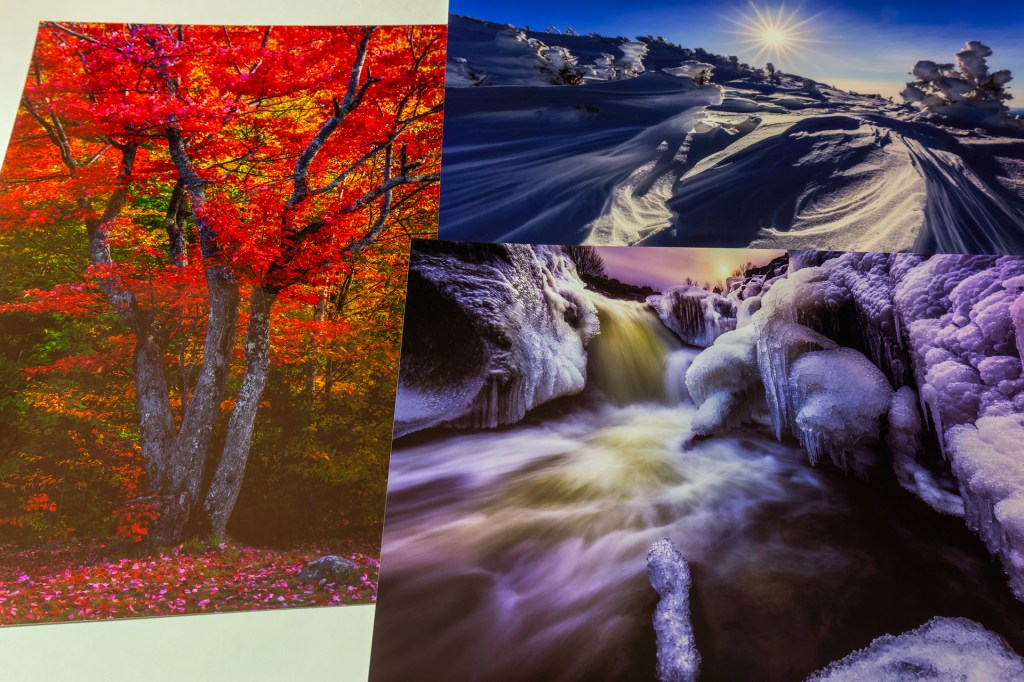
Stating that 2020 has been the most unusual of years surely won’t be news to anyone. I hope that as the year winds down, all of you and your loved ones have been able to stay safe and healthy through all of the challenges that this year has thrown at us. Even in a difficult year like this one, I personally think that rather than vindictively flush 2020 down the drain, it’s important to look back and reflect on the year while recognizing the bright spots that we enjoyed, even if they were few and far between. Even with all the sacrifices that had to be made this year, I feel incredibly fortunate to have still been able to get outside to explore and photograph the great outdoors so much this year, even if that meant scrapping international and out of state adventures and traveling exclusively in good ol’ Upstate New York. So here are 12 of my favorite photos (plus one bonus!) that I took this year, presented in chronological order (starting with “Ecstasy”). I hope that you enjoy them, and that 2021 will be filled with good health and good times for all!

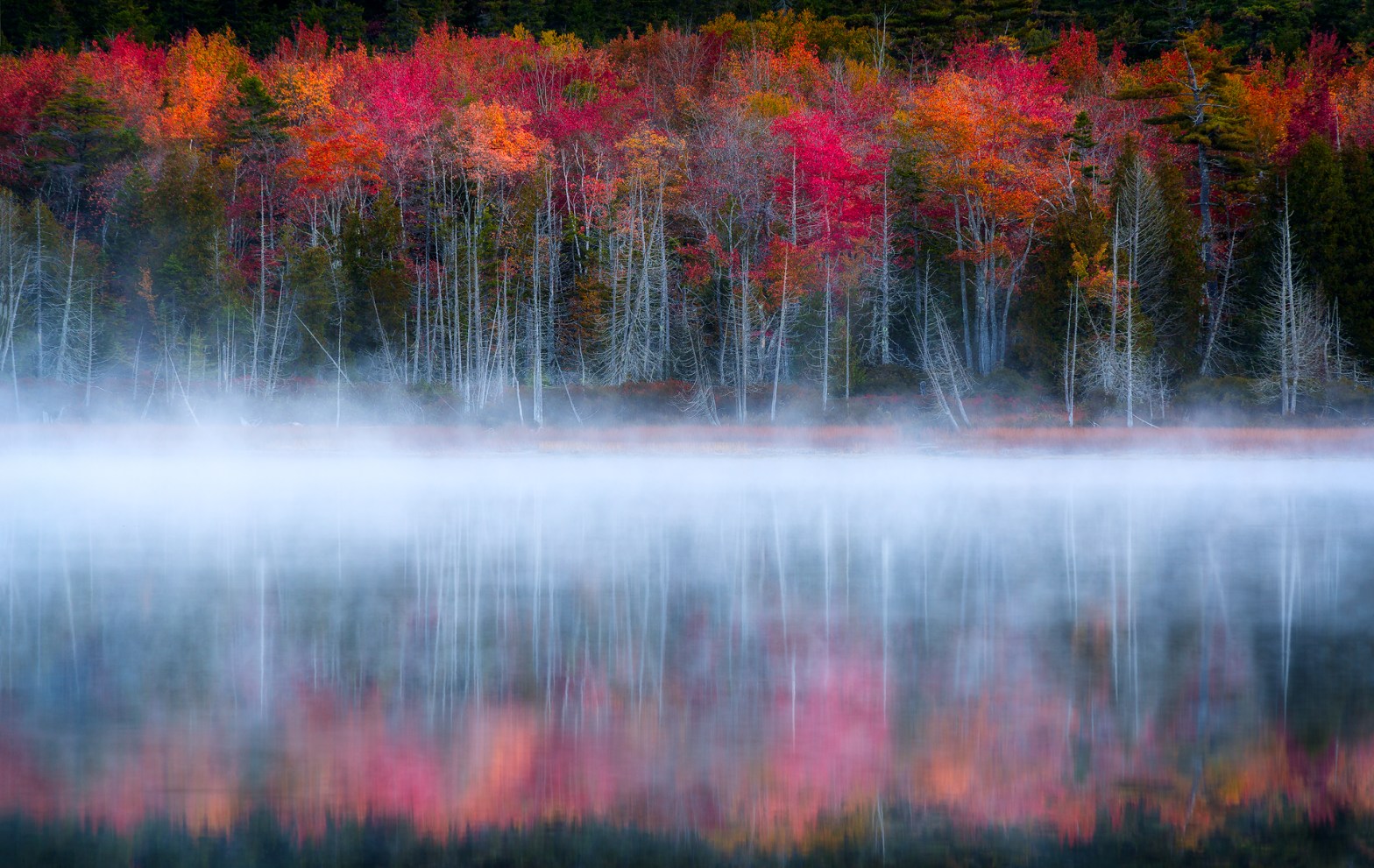
Morning Mirror (opening photo)

Calm, foggy mornings are the perfect time to be out in a canoe, and sometimes the water is so still it feels like you’re floating in a giant mirror. Adirondack Park, New York. Prints available.

Ecstasy

As you can probably tell by the quantity of such photos in my portfolio, the Adirondacks in winter is quite possibly my personal favorite photography subject. In particular, the gnarled and hardy evergreens that occupy tree line and the beginning of the alpine zone make my heart pound and creativity flow unlike anything else found in nature when they become covered with snow in the depths of winter. After climbing the surprisingly deserted trail to the summit of Cascade, I was greeted with a wind-chill that approached -30 degrees Fahrenheit, and a fantasy-land of pure winter magic unlike anything I had seen before. The challenging weather conditions only added to the experience and made it that much more memorable, and as the sun dipped below the distant mountains and the most intense post-sunset glow I’ve ever witnessed emanated through the sky, I raced around like a madman capturing as many photos as I could. After the sky shifted from orange, to pink, to blue, to black, I began my descent down the dark and lonely trail, reveling in the feeling of pure ecstasy that only comes from the wilderness and doing what you love most in the world. Prints available.

Projecting Confidence

Low-angled evening light struck the snowy landscape at just the right angle to allow a little evergreen sapling to project a shadow much larger than the tree itself. Adirondack Mountains, New York Prints available.

The Cozy Cabin

Stars twinkle over a cabin nestled in the Adirondack Mountains. There aren’t many feelings in life better than returning to a cozy cabin with a roaring fire after a day full of winter adventures. This photo appeared in Adirondack Life’s 2020 Cabin Issue. Prints available.

Above All Else

Sometimes a photograph comes to fruition at the spur of the moment, with little to no planning or pre-visualization. Other times, however, much preparation and just the right circumstances are required for a vision to become reality. This photo of sunset from the snowy alpine zone below the summit of Mount Marcy falls squarely into the latter category, as I had been wanting to make this image for the past three winters before everything came together in early March 2020. After the Adirondacks got covered in 3 feet of snow from possibly the last snow storm of the season, I set off from the Adirondack Loj hopeful that I would finally be able to make the images that I had long sought. The trail conditions were fantastic, as other hikers and skiers had thankfully packed the powder down the previous day. As I gradually crept closer to the summit, my excitement grew as I realized that I’d finally have a chance to capture the photo that I sought for so long. I arrived at the summit area later than I had hoped, as I stopped often en route to the summit to photograph the snowy paradise that I hiked through. The quiet serenity of the forest was abruptly replaced by the howling winds of the alpine zone, and I searched out some compositions while struggling to stay warm. As the sun went down and the landscape was bathed in soft light, the beauty of the scene and the fact that I was capturing the photos that I had sought for so long made me forget about the cold and wind and the long hike out in the darkness. As the sky began to darken and I packed up for the journey down the mountain, I took one last look towards the summit of Marcy, and it dawned on me that in that moment, I was the highest person in the state. In elevation, as well as spirit. Adirondack High Peaks, New York. Prints available.

To the Heavens

There’s nothing like exploring the High Peaks after a snowstorm. After photographing the sunset from just below the summit of Marcy (including the previous photo in this post, Above All Else), descending into the sanctuary of the forest was a welcome escape from the hostile, wind-raked alpine zone. Soft moonlight illuminated the snowy evergreens with delicate light, and my descent of the mountain took much longer than it should have as I stopped often to attempt to capture the beauty. I passed this stand of evergreens on my way to the summit earlier in the day, and immediately became enraptured by the large tree on the left of this photo, as I had never before seen a tree caked with so much snow. The light from the moon was just strong enough to illuminate the snowy trees, and a slight halo in the thin fog around the moon added a final touch of etherealness. Knowing that I was the only person still out on the mountain made this moment all the more special, and helped to make the experience one of the most memorable ones I’ve had in these mountains.

On a much sadder note, a few days after returning home from this trip, I heard the news that a 21 year old hiker, Andrew Nichols, had tragically passed away while hiking Dix Mountain (in the southern High Peaks, not too far from Marcy) on the same night that I was on Marcy. Although I didn’t realize it at the time, I had actually driven right by the Dix trailhead, which was filled with the flashing lights of rescue and ranger vehicles, while on my way home. While I had never met Andrew, the fact that he passed away while doing what we both loved, while we were both out doing it on this night, hit me hard. The title of this photo is inspired by these events, and I’d like to think that the halo around the moon was his spirit, making one final ascent, to the heavens.

Adirondack High Peaks, New York. Prints available.

Celestial Fireworks

Fourth of July fireworks and the full “Buck Moon” light up the sky and reflect in the calm waters of Great Sacandaga Lake. I was pleasantly surprised with how this shot came out, especially since I had been enjoying some celebratory beverages throughout the day. Adirondack Park, New York. Prints available.

Morningtide

One of the best things about becoming a canoe owner in 2020? Still being able to explore the wilderness after I busted up my ankle in August. A morning paddle took me out to a rocky little island in the middle of a calm pond, where I thankfully was able to hobble around enough to find this little clutch of grass and flowers nestled in the rocks, with my canoe beached in the distance. Adirondack Park, New York. Prints available.

High on Life

Camping on our own private island on an unseasonably warm autumn day during peak foliage instantly became our all-time favorite camping trip. Indian Lake Islands, Adirondacks. Prints available.

The Scenic Route

Spectacular fall foliage blankets the mountainsides surrounding Indian Lake. The many incredible paddling and hiking options at Indian Lake quickly made this one of our favorite areas of the Adirondacks. Prints available.

An Autumn Haunting

Two small islands appear through thick fog and reflect in a still lake on a late-fall morning. Even after the colorful leaves of autumn drop and fade, there’s still much beauty to be seen and photographed in the wilderness. Adirondack Mountains, New York. Prints available.

Reminiscing

One of my favorite parts of camping with my dad is chatting by the fire, often with a martini in hand, after an exciting day in the woods. While any topic of conversation is enjoyable, some of the most entertaining and memorable stories have been tales from my dad’s youth working as a park ranger at Green Lakes State Park in Syracuse, NY. Green Lake and its neighbor, Round Lake, are both meromictic lakes, which means that their surface and bottom waters don’t mix like most lakes do in the fall and spring. The fact that there are only about 20 meromictic lakes in North America makes Green Lake special, and its made even more unique by the fact that it possesses an incredible blue-green color that seems out of place in Upstate NY and more likely to be found in the tropics. This color comes from the high presence of minerals in the water that seeps through the surrounding bedrock and into the lake. Similar to the turquoise-colored glacial lakes that can be found in the Canadian Rockies and other parts of the world, Green Lake shimmers in otherworldly hues when sunlight hits the water. Green Lakes State Park, New York. Prints available.

BONUS PHOTO – Honor Flight

Although I only planned on including 12 photos in my year-end review, I captured the above photo this past weekend after I had already written the majority of this post. This photo is incredibly dear to my heart, and I’ll detail just how much it means to me below:

It started back in September, while out for a glorious autumn paddle on Indian Lake. All day I’d been thinking about my grandfather, or “Papa” as we affectionately called him, who had passed away in December. A master carpenter, WWII veteran, avid fisherman, loving and devoted husband, father, brother, grandfather, and friend, he was and always will be my hero. Some of my favorite memories are of the days we would spend every August fishing in the Thousand Islands with Papa, and the beautiful scenery and island-studded nature of Indian Lake had been bringing back all sorts of recollections of precious moments that we had shared. As we slowly glided into a calm cove, I mentioned to my wife how this place made me think of Papa, and on cue, as if it had been sent straight from Heaven, we noticed a large bird soaring overhead, coming towards us. “I wish that was a bald eagle,” my wife, Amanda, remarked. “Gosh I know, wouldn’t that be cool?” I replied. As the bird crept closer and closer and began to take shape, though, it became clear that this actually was a bald eagle. We both sat there dumbfounded with our mouths wide open as we watched this magnificent creature circle above us before continuing along, on a fishing trip or perhaps just out for an afternoon joyride, much like we were. Once the shock passed, my wife turned to me and exclaimed “that was Papa coming to say hi!” It seemed very fitting, and made my heart swell with emotion. Bald eagles are prolific fishers and symbols of patriotism, just like Papa.

Fast-forward a few months to December, as the one year anniversary of Papa passing away is drawing near. While up to this point we had never seen a bald eagle in the area where we live, in the week leading up to the anniversary, we saw not one but two bald eagles while running errands around town. As if this wasn’t enough of a sign, we experienced one of the most surreal moments of our lives the morning after the one year anniversary. We were driving back home after a sunrise snowshoe, and were waiting for traffic to pass so we could turn into our apartment. Just as we were about to turn, we saw a large bird flying straight down Route 146, right towards us. “What is that?” my wife said, with a sort of hopeful excitement in her voice that really said “that couldn’t be a bald eagle, could it?” But it was a bald eagle, flying down the busiest road in Clifton Park, right at us. As if this wasn’t freaky enough, we watched the eagle soar across the street before landing in a tree that was right next to Peregrine Senior Living Center, and Papa had spent his final years at a Peregrine in Syracuse. Ever the expert driver, Amanda quickly did a U-turn to park in a church parking lot, across the street from the tree the eagle had landed in. Before heading out for our morning snowshoe, I had decided at the last minute to bring my camera with me in case it was a nice sunrise. As we sat there in our parked car, staring at the eagle as cars unwittingly drove right by it, I knew that I had to get a photo to capture this moment. I was fortunate to get a couple shots off before the eagle took off, and will be forever thankful that “Papa” had the patience (much like on all those hot, fishless days on the River) to stay long enough for me to get some photos of him.

When it was all said and done, my wife and I just stared at each other, speechless, trying to wrap our heads around what had just happened. The chill that I felt run down my neck and spine was a feeling that I had only felt a few times before in my life. I knew, without a shred of doubt in my soul, that the bald eagle we saw was Papa. Coming to say hi. To tell us that he loves us, that he misses us. That while he might no longer be on this earth as we once knew him, he will always be here, watching over us.

How to Appreciate and Photograph Post-Peak Fall Color

Nothing lasts forever, and peak fall color is no exception. Every year it seems that just as quickly as the dog days of summer transitioned to crisp and foggy fall mornings, the once vibrant colors of fall have faded and the trees are left solemnly standing bare, ready to face another long and cold winter. Fall color can be as unpredictable as it is fleeting, and even when planning months in advance and booking that perfect campsite or cabin during what is supposed to be peak color, oftentimes autumn throws us a curveball and decides to peak early, which has happened throughout much of the Northeast this year. While it’s difficult to not feel at least a twinge of disappoint when fall has passed its peak, there are still a bounty of picturesque wonders to be found in the late-autumn forest.

Treasures of the Forest: Freshly fallen maple leaves rest on a piece of birch bark in the Adirondack Mountains. Prints available.

Fallen leaves can be just as colorful and pretty on the ground as they were on the branches from which they came, especially after a strong wind has blown them from the trees before their color began to dull. Different trees tend to lose their leaves at different times, and strolling down a trail littered with fallen maple leaves while the beeches and oaks still retain their golden leaves is a joy to the senses. Fallen leaves make for interesting photographs, and are perfect for abstract and macro shots. Leaves covered in dew or raindrops are a particularly interesting late-autumn photography subject, and can make for truly unique images that stand out from the crowd. This is a great time to utilize a macro lens to create frame-filling shots of colorful fallen leaves, revealing an incredibly intricate world of textures and shapes that often go unnoticed.

Sun Drops: Sunshine brings out the intricate details of raindrops on freshly fallen autumn leaves. Prints available.

Another way to appreciate fallen leaves and use them for creative photos is to seek out eddies in creeks or small rivers where fallen leaves have gathered. These nooks in the shore often cause the water to slowly move in a swirling circular motion that’s difficult to perceive with the naked eye, but can be revealed in a photo by using a multi-second exposure. Depending on how bright it is out, a natural density filter, which reduces the amount of light that reaches the camera sensor, may be necessary to facilitate an exposure that’s long enough to capture a pleasing swirling motion. This type of photography is fun and dynamic, as no two photos are the same. Experiment with different shutter speeds and try tossing a handful of leaves from the nearby ground into the water to see how the number of leaves can drastically alter the photo outcome.

Relativity: The motion of fallen leaves swirling in the eddy of a creek was revealed using a multi-second exposure. Even after fall colors are past peak, as the leaves begin to drop new opportunities for photography are created. Prints available.

Bare trees that have bid adieu to their leaves until the spring also make for an intriguing photography subject. These trees are interesting in their own right as a standalone subject when isolated from the grand landscape with a telephoto lens, especially when a thick veil of morning fog obscures the background and simplifies the landscape. Mountainsides with trees that still have colorful leaves and some that are bare make for a thought-provoking contrast in color and form, and on a deeper level can make one think about the fragility and ephemerality of life. Forests and mountainsides on the edge of open meadows are great places to view and photograph this contrast of life and death, especially at sunrise or sunset when colorful clouds fill the sky.

An Autumn Haunting: Two small islands appear through thick fog and reflect in a still lake on a late-fall morning. Prints available.

Just because the majority of leaves have fallen and autumn is well past its peak, it doesn’t mean that there isn’t still beauty to be found in the fall forest. So the next time you look at a foliage report and see that colors are past peak, don’t hesitate to still get out and discover the splendor that the late-autumn season has to offer, likely in much more solitude than during peak color.

Bare it All: Bare trees and late autumn color on a mountainside at sunset in the Adirondack Mountains. Prints available.

Four Incredible Fall Backpacking Trips in West Virginia’s Potomac Highlands

With fall foliage that rivals New England, a unique topography reminiscent of the Alaskan and Canadian tundra, and a bevy of wilderness areas flush with epic views but lacking crowds and complex permit systems, the Potomac Highlands of West Virginia possess some of the finest fall backpacking trips in America. From a quick and easy overnight to a multiday odyssey far from official trails, this article will go over four of the best backpacking trips that can be found in this part of Appalachia, each of which showcases the many reasons why “Wild, Wonderful West Virginia” should be at the top of your fall backpacking bucket list.

  • Table Rock

For an easy introduction to what fall backpacking in the Potomac Highlands is all about, head to the Canaan Mountain Backcountry Area and tackle the 2.4 mile roundtrip trek to Table Rock. With a short distance, minimal elevation gain, and astonishing views, Table Rock might be the best bang-for-the-buck hike in the entire state.  Even better, this trail receives surprisingly light hiking pressure since the majority of backpackers head to the nearby Dolly Sods Wilderness. From the small trailhead parking lot on Canaan Loop Road, take the Table Rock Trail through a pretty forest of hardwoods that will be bursting with color in late September and early October. After 1.2 mostly flat miles, break out of the forest onto appropriately named Table Rock, and behold a 180-degree view of mountains and the Cheat River Valley. Ne mindful of crevasses in the rock as you explore, and then set up camp at a protected campsite back in the woods that was passed just before reaching the overlook. Or, if the weather is clear and calm, consider sleeping under the stars out on Table Rock. Wherever you decide to camp, be sure to pack in all the water you’ll need, as there isn’t a water source on this trip. Rise early the next morning to have your coffee while watching the sunrise illuminate the fog-filled valley and colorful autumn foliage before making the return trip to the car.

Autumn in Appalachia: An incredible early autumn sunrise from one of my favorite spots in West Virginia, Table Rock. One of the many reasons that I love backcountry camping so much is that it allows me to roll out of my tent and walk just a few feet to witness and photograph scenes like this. Prints available.
  • Total distance: 2.4 miles
    • Recommended trip length: 1-2 nights
    • Getting there: from the town of Davis (a delightful mountain town worth a visit before or after your hike), head south on WV 32 for 3.3 miles, then turn right on Canaan Loop Road. Continue for 10 miles before reaching the trailhead on the left. Note: while Canaan Loop Road is a well-maintained gravel road when approached from WV 32, it quickly deteriorates into a rugged 4×4 road shortly after the Table Rock trailhead. Google Maps trailhead pin.
  • Dolly Sods Wilderness

Dolly Sods Wilderness is one of the most popular and well-known wilderness areas in West Virginia, and for good reason. With a vast network of trails, a bounty of campsites and several overlooks that provide panoramic views of nothing but seemingly endless wilderness, there are countless routes in Dolly Sods that are perfect for a fall backpacking trip. Since Dolly Sods is a designated Wilderness, be prepared for minimal or no trail markings and to ford creek crossings, all of which helps to preserve a true wilderness feel as much as possible. For a lollipop loop that showcases the best of Dolly Sods, take the Rohrbaugh Plains Trail north from the Dolly Sods Picnic Area on Forest Service Road 19. In 2.5 miles, the first great views of the trip can be had from a rocky outcrop just off the trail. This overlook on the edge of Red Creek Canyon provides some of the best views in Dolly Sods, with Red Creek Valley below framed by Breathed Mountain and Rohrbaugh Plains. While only 2.5 miles from the trailhead, the view from here is so astounding that it’s worth spending a night at one of the campsites dispersed in the woods near the overlook. Sunsets from here are incredible, and on cool fall mornings fog often fills the valley below, making for truly dreamy photo conditions.

Perspective: Beams of light break through dramatic clouds shortly before sunset, as a lone hiker takes in the view from a rocky perch high above Red Creek. Dolly Sods Wilderness, West Virginia.

After breaking camp, continue on the Rohrbaugh Plains Trail and pass the Wildlife Trail on the right at 3.1 miles. Continue straight and drop down into Red Creek Canyon and cross Fisher Spring Run at 3.4 miles. Follow Fisher Spring Run Trail down to Red Creek, and pick up the Red Creek Trail to begin a 10 mile counterclockwise loop. Reach Rocky Point Trail on the left at 4.4 miles, which makes for a great side trip (~2 miles roundtrip) up to Lions Head, a rocky overlook that provides one of the best views in Dolly Sods, and possible campsites nearby. Continuing north from the junction with Rocky Point Trail on the Red Creek Trail, reach the Breathed Mountain Trail at 6.0 miles. This trip takes you left down the Breathed Mountain Trail, but one could also continue straight down the Red Creek Trail to arrive at a fantastic and popular camping area near some waterfalls on Red Creek called “The Forks.” Back at the junction with the Breathed Mountain Trail, take this trail west for 2.4 miles and travel through a beautiful forest of spruce and blueberry bogs. This combination of forest flora is more commonly found in the boreal forests of Canada than the Appalachian Mountains, and is especially beautiful in autumn when the berry bushes turn bright red and are a perfect contrast to the dark green spruce forests.  Arrive at the Big Stonecoal Trail at 8.5 miles and turn left to head south down this trail for 2.4 miles before arriving at a trail junction with the Dunkenbarger Trail. Excellent campsites along Big Stonecoal Run can be found here. Continuing south on Big Stonecoal Trail, the western end of the Rocky Point Trail to Lions Head is passed on the left at 11.6 miles, and in 1.4 more miles ford Red Creek and arrive back at Red Creek Trail at 13.0 miles. The banks of Red Creek possess several wonderful campsites, and Red Creek (named for the reddish-brown tint of the water caused by a high tannins concentration from decomposing red spruce and hemlock needles) is perfect for cooling tired feet after a long day on the trail. Continue heading northeast along the Red Creek Trail for 1.5 miles before hitting the intersection with Fisher Spring Run Trail, at which point you’ll be retracing your steps from the start of the trip back to the parking lot.

  • Total distance: 19.4 miles (~21.5 miles with side-trips to Lions Head and The Forks)
    • Recommended trip length: 3+ nights
    • Getting there: from the town of Petersburg, head south on WV 28 for 8.5 miles, then turn right on Jordan Run Road (CR 28/7). Continue for 1 mile before turning left on Forest Service Road 19 (FS 19). Take FS 19 7.2 miles to the parking lot at Dolly Sods Picnic Area. Google Maps trailhead pin.
  • North Fork Mountain

For fans of ridge hikes with near constant views, it doesn’t get any better than an autumn trek along North Fork Mountain. The full length of the ridge hike is just under 25 miles in total from end to end and makes a great shuttle hike if a car can be dropped at both trailheads (it’s about a 40 minute drive one-way between the north and south trailheads). It’s also possible to break this up into smaller shuttle sections, especially if starting from the northern trailhead. From the northern trailhead on CR 28 (Smoke Hole Rd.), ascend switchbacks for 1.6 miles to gain the ridge. Once up on the ridge, views and campsites abound, and there is minimal elevation change. Hike south and take a short side trail on the right that leads to Chimney Top, which provides a spectacular view of distant mountains and autumn foliage peppering the pastoral countryside far below. Countless other vistas await further down the trail, as the ridge never strays far from a clear view. Three quarters of a mile further south, pass another fine vista, Table Rock (not the same Table Rock as the one previously discussed at the start of this article). If short on time or energy, this makes for a great stopping point, and several nice campsites can be found dispersed in the forest not far from the trail that provide easy access to sunset views from the ridge. From Table Rock, the trail ambles south and passes two spur trails that descend east off the ridge: Landis Trail and Redman Run Trail, reached 4.1 and 8.2 miles from the north trailhead, respectively. Taking either of these trails would provide a shorter shuttle hike alternative.

The main disadvantage of being up on the ridge is the scarcity of water. Save for a semi-reliable spring that’s passed halfway through the trail, there’s no water sources up on the ridge, and it’s thus best to pack in enough water to last the length of the trip in case the spring is dry.

The views continue on the southern portion of the trail, with so many overlooks that they don’t even have names. While the north half of the trail is more interesting, the southern half is still beautiful, and completing the full length of the trail is a rewarding and recommended experience.

  • Total distance: 24.7 miles for full shuttle
    • Recommended trip length: 2-3 nights
    • Getting there:  North trailhead: from the town of Cabins, head west on North Fork Highway (WV 28) for 1.8 miles. Turn left on Smoke Hole Road (CR28/11) for 0.4 miles until reaching the parking lot on the right. South trailhead: from the north trailhead, head back to WV28 and turn left. Head south for 26 miles, turn left onto Mountaineer Drive (US 33-E) and arrive at the trailhead parking lot on the left in 4.7 miles. Google Maps trailhead pins: North, South.
  • Roaring Plains

For the seasoned backpacker looking for a trip that’s as challenging as it is scenic, there’s no better destination in the Potomac Highlands than a part off-trail wilderness sojourn in the Roaring Plains West Wilderness. Backpackers with the necessary skills are rewarded with some of the most incomparable solitude, views, and campsites to be found not only in West Virginia, but the entire East Coast. Given the largely off-trail nature of this route, it’s wise to budget extra time in case you get turned around, and to pack a map and compass and know how to use them. A GPS could also be incredibly useful for this trip.

There are several possible routes that can be taken into the Roaring Plains, with the eastern fork of the South Prong Trail (which begins just a half mile down FS 19 from the start of the aforementioned Dolly Sods Wilderness trip) offering a pleasant, relatively flat portal to the rugged terrain that lies ahead. After heading south for approximately 2.5 miles on the oftentimes wet and muddy South Prong Trail, the real fun begins. Look for an unofficial trail on the left, not marked with a trail sign but often marked with a cairn, which heads in a southwest direction through the forest. Take it slow, keeping an eye on your compass and be on the lookout for more cairns marking the way along the faint trail, known as the “Hidden Passage.” After almost a mile of picking your way through the forest, break out into an open meadow with expansive views. Soon after arriving at the meadow, the trail passes one of the finest campsites imaginable, nestled in the flame-red berry bushes and with the kind of expansive, open views that are hard to come by when backcountry camping in the East. This area makes a great basecamp option to do day hikes from, with the top hiking option being an off-trail journey along the rim of Long Run Canyon.

The One That Started it All: A beautiful autumn sunrise at one of my all-time favorite campsites, in the meadows of West Virginia’s Roaring Plains West Wilderness. Some of the best backpacking, views, and campsites in the East can be found here.

To get Long Run Canyon from the meadows campsite, follow a faint, unmarked trail for about 0.7 miles through the open meadows, until reaching the Pipeline Swath (essentially an old dirt road). A small trickling creek located at this junction is one of the only water sources if camping at the meadows and for the duration of the loop along Long Run Canyon, so top off water bottles here and be sure to treat the water. Take a left to head southeast on the Pipeline for about 0.3 miles until arriving at the remains of an old road, where the real adventure begins. Turning right, dive into the bush and head in a west-northwest direction to reach the rim of Long Run Canyon. Scan for a faint path possibly marked with cairns or flagging, and budget extra time for this section of the hike, as it’s the sketchiest part from a navigation standpoint. Once you arrive at the canyon rim, the trail is much easier to follow. When in doubt, ensure that the canyon is on your left. The next 2.5 miles are some of finest hiking miles imaginable, with almost constant views out across the canyon into the vast West Virginia wilderness. Heath thickets, spruce, and rocky outcroppings combine to form an incredibly beautiful and unique landscape unlike anything else in the East. While there is minimal elevation change on this section of the hike, since this is an unmaintained trail, there will almost certainly be downed trees to navigate around. While base-camping at the meadows will make the hike along the canyon rim easier, for the hardy backpacker there are several options for camping along the canyon rim. Although water is hard to come by along the canyon, the views and solitude more than make up for the extra effort of hauling in water (if camping on the rim, fill up on water either at the Pipeline creek or at a crossing of Red Creek that’s about 0.6 miles into the hike along the canyon after leaving the pipeline). Some of the best campsites are just past possibly the finest view of the day, at a spot called “The Point,” reached 1.5 miles into the hike along the canyon rim. From The Point, head northwest and in one mile arrive at a large campsite with a fire ring.  On the north side of the campsite, look for a cairn and the start of your journey away from the canyon rim on the Tee-Pee “trail.” Another unofficial trail that can be a pain to follow, it’s best to set a northeast compass bearing and do your best to follow the faint boot path while sticking to the compass bearing. A half-mile bushwhack will lead to the Roaring Plains Trail, which is an official Forest Service trail. Turn right (east) onto the Roaring Plains trail, and in 0.9 miles again reach the Pipeline Swath. Turn right onto the Pipeline, and head southwest for one mile before arriving back at the base of the meadows, where you’ll turn left and retrace your steps from earlier in the day to return to basecamp in the meadows, having completed one of the most rugged and beautiful fall hikes imaginable.

  • Total distance: ~14 miles
    • Recommended trip length: 2-3 nights or more to budget for potential bad weather and for increased photography opportunities.
    • Getting there:  From the town of Petersburg, head south on WV 28 for 8.5 miles, then turn right on Jordan Run Road (CR 28/7). Continue for 1 mile before turning left on FS 19. Take FS 19 6.0 miles then bear left at the intersection with FS 75 to continue on FS 19 for 1 mile to the parking lot for upper South Prong Trail on the left. Google Maps trailhead pin.

Note: this article can also be found at Eastern Mountain Sports.

Escape the Leaf-Peeping Crowds by Boat and Boot at Indian Lake

Autumn is upon us, and the vast hardwood forests of the Northeast are putting on their annual show that rivals any natural spectacle in the world. While the fall season has always been a popular time for hikers and roadside tourists alike to get out and explore, larger crowds than usual are expected this fall due to COVID-19 and the fact that being outside is one of the safest ways to get away from home during these tough times. The Adirondack Mountains have long been a haven for stressed and overworked city dwellers to get back to nature, and unsurprisingly the ever-popular High Peaks region has been experiencing record visitation throughout the summer and early fall. Hoping to avoid the maddening crowds while simultaneously exploring a part of the Adirondacks that we had yet to properly experience, my wife, dog and I recently went on a canoe camping trip to Indian Lake that quickly became our all-time favorite camping trip.

Take a Peep: A wall of fog on Indian Lake catches the morning sunlight as the tips of distant mountains peek above the fog. Prints available.

Located in the Southern Adirondacks, approximately a 70 mile and 90-minute drive southwest from Lake Placid, Indian Lake is a 12-mile-long reservoir that runs southwest from the tiny town of Indian Lake. While not quite as wild (the west shore has some development) as some of the more remote ponds and lakes of the Adirondacks, Indian Lake still has a relatively remote feel to it, especially on the eastern shore which is largely Forest Preserve land. The lake is peppered with several rocky islands, ranging in size from nothing more than a few boulders to over 1,000 feet in length.

Fire Island: A small rocky island on Indian Lake catches the morning sun, as seen from the cliffs of another island filled with beautiful fall foliage. Prints available.

The best thing about Indian Lake is that it possesses the Indian Lake Islands Campground, which consists of 55 campsites (each with a picnic table, an outhouse, and firepit) spread along the lakeshore and islands that can only be accessed via boat. Sites can be booked up to 9 months in advance, and while they’re incredibly popular during the summer, as the temperature begins to drop in the fall, so does the visitation. Note: due to COVID-19, the DEC and New York State Parks has temporarily lifted the 9-month reservation window restriction for camping at New York State Parks, including Indian Lake Islands, and bookings for 2021 are currently being accepted.

Second Summer: A couple enjoys an afternoon paddle on a warm September day that looked like autumn but felt like summer. Prints available.

While all of the campsites offer privacy and outstanding views, nothing can beat the experience of camping on your very own private island. Of the 55 campsites at Indian Lake, five of them are on an island with no other campsites. Of this handful of select sites, the most outstanding site might be campsite 2 on Kirpens Island, which offers several advantages compared to the other sites. Situated due east from Indian Lake Marina (518-648-5459), the campsite on Kirpens Island can be quickly accessed via a 20-30 minute, mile-long paddle if launching from the marina, as compared to the 8-mile-long paddle if starting from the access point and campground check-in center on the south end of the lake.

Another plus of starting from the marina is that it makes renting a canoe or kayak easy if you don’t own a boat, although rentals for the 2020 season have been suspended due to COVID-19. Kirpens Island is also one of the largest islands on Indian Lake, with countless nooks and crannies along the shore to explore, as well as some informal trails that lead to the far reaches of the island from the camping area on the north side of the island. A number of smaller islands surround Kirpens and make interesting photography subjects, especially in the fall when the berry bushes, maples, and birches that are prevalent on the islands show off their fall colors.

Isolation: A lone maple tree that has somehow managed to take root in a narrow, rocky island shows off its bright fall color as it watches the mountains peek above pre-sunrise fog on Indian Lake. Prints available.

What really sets Kirpens Island apart from the other sites at Indian Lake, though, is its proximity to the Baldface Mountain trailhead. The trailhead is a quick five-minute paddle east from camp into a quiet bay and is only accessible by boat. This difficulty of access greatly minimizes the crowds, and on a beautiful Saturday with near-peak foliage conditions, we had the trail and summit all to ourselves. After beaching your boat on the shore near a large boulder marked with white paint, an easy 0.8-mile-long trail with red trail markers and 550 feet of elevation gain weaves through the forest before breaking out on a rocky ledge perched just above the treetops, with the long blue swath of Indian Lake and its islands spreading out in the distance. Fall views don’t get any better than this, as the predominantly hardwood forest that surrounds Indian Lake bursts with a vibrant array of red, orange, yellow, and purple in late September to early October. After enjoying the view from Baldface, head back down to the lake and explore the islands near Kirpens, marveling at the banded metamorphic bedrock that the islands consist of, which makes for fantastic photo opportunities.

Autumn Riches: Spectacular fall foliage blankets the mountainsides surrounding Indian Lake. The many incredible paddling and hiking options at Indian Lake quickly made this one of our favorite areas of the Adirondacks. Prints available.

Once back at camp, cap off a spectacular day of autumn exploration in complete solitude by watching the sun set over Indian Lake and Snowy Mountain from an open ledge high above the lake on the west side of the island, and perhaps raise a glass of your favorite beverage to toast your own private piece of autumn heaven.

Radiance: Delicate morning fog glows with the soft light of sunrise over a mountainside bursting with every fall color imaginable. Prints available.

The Heart of Autumn

With all due respect to the other seasons, there isn’t a more exciting time of year for wilderness exploration and photography than fall, and there’s no better place to be this time of year than the Eastern United States. Blessed with a variety of hardwood species like sugar maple and birch that turn practically every shade of color imaginable during the autumn season, there’s no shortage of fantastic foliage destinations in this part of the country. That said, there are some locations that stand out from the rest, such as the Heart Lake area in New York’s Adirondack Mountains.

Located south of Lake Placid in the High Peaks Region, Heart Lake is a perfect fall hiking and photography destination. While the main sights can be seen in just a daytrip, to truly appreciate this special area, nothing beats spending a few nights in a classic Adirondack lean-to, several of which pepper the lakeshore and surrounding forest. Or if camping isn’t your style, the charming and cozy Adirondack Loj is also near the lake and offers the weary hiker heated rooms and home-cooked meals.

Another big advantage of staying at Heart Lake is that some of the best fall photography imaginable is right at your doorstep. The following tips will help you make the most of a fall trip to Heart Lake and to take your fall photos to the next level. While this article is focused on the Heart Lake area, most of the photography tips can be applied to any locale.

Patience – Beautiful autumn foliage blankets the side of Mount Jo as the morning fog breaks just enough to allow the rising sun to bathe the landscape in warm light. Prints available.

Time it Right

The first consideration when planning a fall photography trip to Heart Lake or elsewhere is timing. While difficult to predict and variable from year to year, peak fall foliage in this part of New York typically arrives in the last week of September and lasts through the first week of October. Peak fall color at Heart Lake the past two years has been right around October 5th. Once September arrives and preparation for fall kicks into high gear, the Adirondack Mountain Club posts a weekly Heart Lake foliage report on their social media pages that is an incredibly useful resource for monitoring the color progression remotely. If looking to explore other areas in the Adirondacks or New York State, I Love New York posts a weekly foliage report for the entire state on their website and social media pages.

Eye for Autumn – Peak fall colors ring Heart Lake, as seen from Mount Jo. Prints available.

Even if you miss peak color, there can be advantages to being a little on the early or late side. In the days leading up to peak color, the prominence of some trees with green leaves that have yet to change color can make the ones that have changed pop even more. Post-peak when the leaves begin to fall is a great opportunity to experiment with detailed macro shots of freshly fallen leaves and can provide the opportunity to catch the first snow of the season as autumn color hangs on before succumbing to the white of winter.

Scout It Out

One of the best ways to get to know an area and to take the best photos possible is to get out and explore and scout out different compositions upon arrival, especially if never having been to the location before. Spending at least a couple days in an area is also advantageous as it provides more time to study weather patterns and to get a better understanding of how the light interacts with the landscape at different times of the day. Scouting is rather easy to do in the Heart Lake vicinity, but there are a few classic spots where photography is worthwhile:

Heart Lake

The lake itself offers a bounty of photo opportunities, and a hiking trail leads around the eastern half of it and provides several access points to the lake. Even better, snag one of the lakefront lean-tos, which can be reserved up to a year in advance, and your own slice of private lakefront will be just steps away. A sandy beach on the north side of the lake is an excellent spot to photograph mountain reflections or a canoe beached on the sandy shore with a background of colorful foliage.

Front Row Seat – A sugar maple along the shore of Heart Lake shows off its autumn colors as Mount Jo looms in the distance. Prints available.

Mount Jo

Rising above the north shore of Heart Lake, 2,876-foot Mount Jo provides one of the most phenomenal fall views and is one of the best bang-for the-buck hikes in all the Adirondacks. A typical rugged and steep Adirondack trail leads from the campground to the rocky summit ledges. Partway up the Mount Jo trail, the trail forks into the “Short” and “Long” trails  which ultimately meet below the summit. Reaching the summit via the Short trail requires a 1.1 mile one-way hike, as compared to the Long trail which is 1.3 miles. A total ascent of 700 feet is gained whether taking the Short or Long trail, so while the Short trail saves two tenths of a mile, it’s steeper than the Long trail. It takes roughly 45 minutes to get to the top, where a glorious view of mountains and fall foliage spreads out below. The opportunities for landscape shots with a wide-angle lens are endless, and since the view looks to the south, great sidelight can be had at both sunrise and sunset. While views from the official summit are nice, some open ledges below the summit provide an even more panoramic view with a clear perspective of Heart Lake surrounded by colorful autumn foliage with Algonquin and other High Peaks rising from the valley further to the south.

Icing on the Cake – Peak autumn foliage spreads out below the snow-capped summit of Algonquin Peak, as morning fog drifts off the surface of Heart Lake on a cold October morning a half hour before sunrise. Prints available.

Heart Lake Campground

Spending the night camping at Heart Lake opens up additional photo opportunities. Campers by a crackling fire and tents or lean-tos nestled in the forest are great additions to any fall photography portfolio and help to fully paint the picture of what fall in the mountains is all about. Lean-tos, tent campsites, and bunks in the Loj can be reserved online at the Adirondack Mountain Club’s website or over the phone (518-523-3441). Lean-tos and tent sites cost $40-$45 per night, and Loj rooms range from $70-$160. For all Heart Lake accommodations, Adirondack Mountain Club members receive a 10% discount.

The Tree – A maple tree within the Heart Lake Campground in all its autumn glory. An Adirondack Mountain Club volunteer that I met while making this image told me that she knew someone that had been coming to the campground every autumn for 30 years, who used this tree as a gauge for autumn’s progress. The gauge was reading “Peak” on this October morning! Prints available.

Mornings are Magic

As difficult as it can be to crawl out of a toasty sleeping bag to feel the cold slap of predawn air, there’s no better time of day for fall photography than early morning. Winds at Heart Lake are typically calmest at dawn, better facilitating the reflection of colorful foliage and clouds in the lake. Fog rising from the lake on crisp autumn mornings is a common occurrence and provides some of the most dreamy and mystical photography conditions imaginable, whether photographed from the shore of the lake itself or from a higher vantage point up on Mount Jo. On especially cold mornings, frost might even coat the flora, adding a special touch to an already extraordinary time of year.

Look Beyond the Grand Landscape

When color is at its peak, the most obvious way to capture the beauty is to use a wide-angle lens to capture grand landscape photos. To create a more diverse portfolio and to truly capture the full essence of fall, though, it’s important to look beyond the landscape and find the subtle beauty of fall. One of the best ways to do this is to use other lenses besides a wide-angle. Utilizing a telephoto lens is a great way to isolate smaller sections of a landscape, and it can be a fun exercise in creativity to start with photographing the landscape using a wide-angle lens and then switch over to a telephoto to pick out different compositions from within the wider shot. From the shore of Heart Lake, use a telephoto lens to create a frame-filling shot of the most colorful group of trees, or a lone red maple amid a group of evergreens. From the summit of Mount Jo, hone in on morning fog floating over the top of the forest canopy, or a canoe on Heart Lake dwarfed by the immense scale of the Adirondack wilderness.

Hover – Fog glides over the treetops on a cold October morning. Using a telephoto lens while shooting from the summit of Mount Jo allowed me to isolate this section of forest and fog far below. Prints available.

On the opposite end of the spectrum from an expansive landscape photo, macro photography can reveal an intimate and abstract side of fall that often goes unnoticed. With macro photography, a small section of a single leaf can be as beautiful and profound as a grand vista filled with millions of leaves.

Intricacy – a macro lens is perfect for revealing the intricate, seldom appreciated details of autumn. Prints available.

Pack a Tripod and Polarizer

Two of the most useful accessories for fall photography not only at Heart Lake but in general are a tripod and polarizing filter. Unless intentionally blurring some or all of a photo for creative reasons, it’s typically desirable for a photo to be in sharp focus from front to back. A tripod is often necessary to stabilize the camera and facilitate a sharp photo, especially at dawn and dusk when there’s less light and longer exposure times are required. A polarizer comes in handy throughout the year but is especially useful in fall. Much like the polarized sunglasses that you might own, putting a polarizing filter on a camera lens helps to decrease glare and haze. Using one helps to make fall colors really pop, especially when the leaves are wet. A polarizer also helps to deepen the color of a blue sky, although care should be taken not to overdo it and end up with an unnatural polarization gradient in the sky. To avoid this, twist the polarizer back and forth until the most pleasing effect is achieved, especially when photographing at a 90-degree angle to the sun, at which the polarization effect is most prominent.

Get Out and Explore

While there are enough interesting photography subjects at Heart Lake to keep a photographer entertained for days on end, there are also several other nearby locations that can all be reached on foot that are worth investigating if on an extended stay in the area. About a mile up the road from the Heart Lake Campground, a trail to Mount Van Hoevenberg begins off South Meadows Road and leads to another short mountain with an open, rocky summit that provides a different perspective than Mount Jo. En-route to the summit, pass a beaver pond that provides an excellent view of Mount Van Hoevenberg to the north. For a less strenuous diversion from Heart Lake, continue to the end of South Meadows Road by foot or car to photograph pretty meadows complete with a babbling brook.

Heart Lake also provides easy access to hiking some of the most popular High Peaks, such as Algonquin, Marcy, and Phelps. It should be noted though that while the tundra of these peaks can sport pretty autumn alpine grasses, the best fall colors will be well below these lofty summits.

For a more secluded leg-stretcher than hitting a High Peak, loop around the north side of Heart Lake to connect with the Indian Pass Trail. Reach beautiful Rocky Falls in a little over two miles, with the option to continue on approximately three more miles to rugged and seldom-visited Indian Pass.

On the drive to and from Heart Lake on Adirondack Loj Road, several open meadows are passed that make for perfect photography or picnic spots, just be sure not to encroach on any private land.

Fallen for You – Open meadows next to Adirondack Loj Road are perfect for a picnic or a photo-shoot.

Whether spending just an afternoon or an entire week, Heart Lake is a perfect destination for fall photography. With the tips outlined in this article and an open, creative mind, you’ll be sure to come away from your visit with the best fall photos possible.

Note: this article can also be found at Eastern Mountain Sports.

Special Indeed

Over the past few years, much of my free time has been spent exploring and photographing the Adirondack Mountains, and until recently, summer was by far been my least favorite time of year for photography. Lacking the bright colors and moody fog of autumn and the austere beauty of winter, I rather foolishly had convinced myself that there was nothing to see or photograph this time of year except endless blobs of green trees. Add in the crowded trails and swarms of biting insects, and for the most part the past few summers found me daydreaming of fall and all its grandeur rather than getting out to the Adirondacks for exploration and photography. How foolish of me.

In the Weeds: Lily pads and reeds form interesting patterns and lines on the surface of a pond in the Adirondacks. Prints available.  

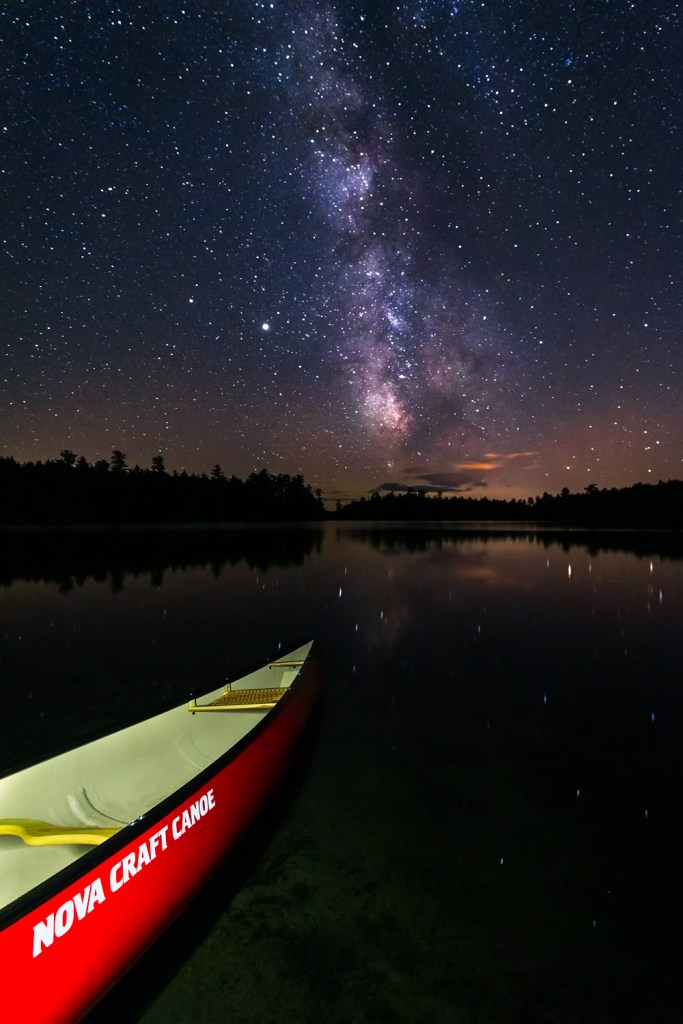
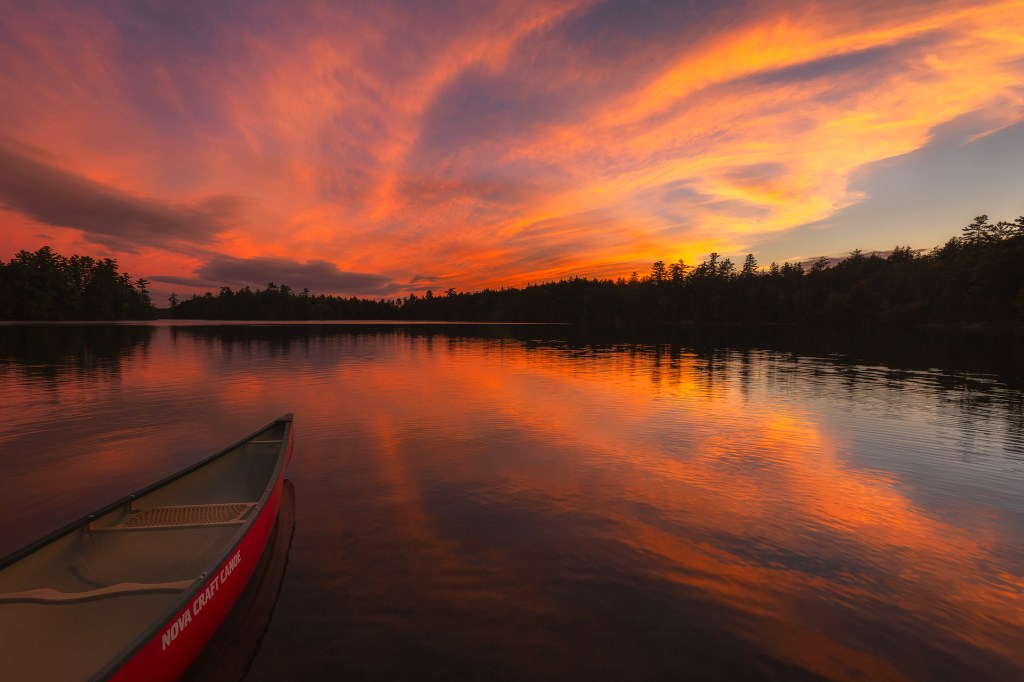
It was a phone call from my dad that I received this past winter that would begin to drastically change my tune regarding summer photography in the Adirondacks. My wife and I had recently gotten married, and my dad was calling to tell me about an idea he had for our wedding gift. I can’t recall what I was expecting him to suggest, but it definitely was not what he proposed: a canoe. “Are you serious?!” I blurted out, and then spent the next several weeks giddily researching canoes. While I have become a seasoned backpacking veteran over the years, aside from some short paddles while in Cub Scouts decades ago, canoeing was a completely new animal to me with new terminology and techniques to learn. Gunwale, J-stroke, rocker, Kevlar and aramid…what does it all mean? At least I had plenty of time to stay in and familiarize myself with the world of canoeing, as the COVID-19 pandemic took hold of the world just as my research was kicking into high gear. After finally coming to a decision (Nova Craft Canoe’s Bob Special), all that was left to do was anxiously wait for our shiny new toy to arrive.

Land Ho: Our Bob Special rests on the shore of a rocky island in the Adirondacks on a beautiful summer day. Prints available.  

While it may sound like hyperbole, Bobby (the somewhat unoriginal name we’ve bestowed upon our canoe) has been a revelation. As someone that’s always enjoyed jumping into a cool lake more than summiting a mountain on a hot summer day, having the ability to finally explore the countless lakes, rivers, and ponds in the Adirondacks has felt like discovering a whole new park within the Park that I was never privy to. Rocky islands that used to be longingly gazed at from shore are now picnic destinations, crowded trails have been exchanged for open blue water, loons that before were only heard can now be seen, and the “nothing but a green blob” mentality that I used to hold regarding summer photography in the Adirondacks has thankfully become a thing of the past.

Adirondack Icon: When their haunting call floats across the surface of a wild lake on a still summer morning, my awe and appreciation of the Adirondacks is never greater. Prints available.  

One of the best parts about owning a canoe has been that in addition to transporting us to previously inaccessible locations for photography, the canoe itself makes for an entertaining photo subject. While the aesthetics of a canoe and paddles typically are secondary to their actual performance, as a photographer I knew that I wanted a set-up that would not only be a joy to paddle but would also stand out in photos. With its beautiful lines and shiny red finish, the Bob Special has been an even more exciting photo subject than I imagined it would be, and has been my photography muse this summer. A pair of carbon fiber and wood paddles has proven to be an excellent fusion of modern lightweight materials and vintage design and have been a perfect complement to the Bob Special. This set-up has already provided me with hours of entertainment, whether I have a paddle or a camera in my hands.

Moment of Reflection: Clouds reflect in a quiet pond while out for a peaceful evening paddle. Prints available.  

I’ve been wrong about many things in my life (who wasn’t?) and holding the belief that there’s not much worth photographing in the Adirondacks in the summer months was surely one of my bigger gaffes. Becoming the proud owner of a Nova Craft Canoe has not only changed the way I view summer photography and wilderness exploration in the Adirondacks but has also been a shining light in my life amid the seemingly never-ending darkness that is the year 2020. I hope that all of you have been able to latch onto something these past few months that has been a beacon of hope in your life like how the canoe has been mine, and that you’ve been able to seek out and experience the healing power of nature.

2021 Calendars Available For Purchase

2021 wall calendars are now available for purchase! This year’s calendar features wilderness images from the Adirondack Mountains, Canadian Rockies, Quirpon Island (Newfoundland), Baxter State Park (Maine), Georgian Bay (Ontario), Zion National Park (Utah), Saona Island (Dominican Republic), and Giant’s Causeway (Northern Ireland). Similar to last year, the image for each month and calendar grid are both 11″ x 8.5″. Some minor changes have also been made to improve on last year’s design:

  • Addition of holidays/events, including Daylight Saving and seasonal equinoxes/solstices
  • Slightly larger monthly date grid
  • A small blurb about each monthly image to go along with the image title and location

These calendars make a perfect addition to the home or office, and will inspire you throughout the year. The price is the same as last year, $18, and can be purchased via Venmo (@Joseph-Priola), PayPal (jpriola1@gmail.com), or by cash/check. Shipping is included, but if 3 or more calendars are purchased and shipped, there will be an extra $4 charge to account for the increased cost of shipping. If purchasing a calendar via Venmo or PayPal, please include your shipping address in the request, or contact me here on the blog or message me on Instagram (@PriolaPhotography). Thank you, and here’s to 2021 being our best year yet!

Photographing the Puffins of Machias Seal Island

In a hypothetical contest to crown the world’s cutest animal, the Atlantic Puffin almost certainly has to be in contention. Curious, playful, colorful, and awe-inspiring, there’s something about puffins that seems to always put a smile on your face. Atlantic Puffins can be viewed in the wild throughout the North Atlantic, from Ireland to Iceland to coastal New England, and viewing them in their natural habitat is a memorable experience no matter where in the world you might be. While I admittedly have not traveled the world seeking out the best puffin viewing experiences, I think that photographers and animal lovers alike would be hard-pressed to find a more magical puffin viewing experience than what lies on a small, deserted island in disputed waters about 10 miles off the coast of Maine. After setting sail from the small coastal town of Cutler for an hour long boat ride, visitors arrive at Machias Seal Island, a haven for seabirds in the summer months. Only 20 acres in size and completely wild save for an automated lighthouse, Machias Seal Island is home to the largest puffin colony on the coast of Maine. While a variety of other seabirds (and sometimes seals!) such as Razorbills, Common Murres and Arctic Terns nest on the island in the summer and add some variety to the bird viewing, almost everyone ventures here specifically to see the puffins. Once on the island, visitors are escorted down boardwalks to small wooden observation blinds, which hold 3-4 people each.

Small observation blinds on the island allow for an intimate, one-of-a-kind bird watching experience.

The blinds are strategically placed along the rocky shore, and are what make the puffin viewing experience at Machias Seal Island so incredibly special and unique. Instead of having to carefully “stalk” the puffins to get close enough to take pictures, while possibly disturbing them and their natural habitat in the process, the blinds allow visitors to get within feet of the puffins without them even knowing that they have company. Small windows in the blinds open just enough to peer out of and stick a camera lens out, and although about two hours is spent in the blinds, the high level of excitement makes the time fly by.

Jaw Dropper: A beautiful Atlantic Puffin opens its mouth and calls out to its friends on Machias Seal Island, which possesses the largest population of puffins on the Maine coast. Prints available.

Although the vast majority of my wilderness photography focuses on landscapes, I was excited to give bird photography a try, and can now say that I am hooked! Here are some tips and suggestions for coming away with the best photos possible of these majestic creatures:

  • Bring the longest telephoto lens possible
    • I arrived at the island knowing that I wanted to focus on getting intimate portraits of the puffins in their natural habitat, which meant that I would be utilizing longer focal lengths. Unfortunately, since I spend most of the time photographing landscapes, the “weakest” lens in my arsenal at the time was my telephoto, which had a maximum focal length of 300mm on a full-frame sensor camera. When the puffins were just a couple feet from the blind, at 300mm I was able to get close-up, frame-filling shots, but I often found myself wishing that I had a longer lens, and I had to crop several of my best shots in post-production in order to get the tight composition that I truly wanted. In hindsight, having the ability to use a 400-500mm focal length with perhaps even a teleconverter as well would have been preferred, and I’ve since invested in just such a setup to utilize on future wildlife photography outings.
She Said I’m Cute: A telephoto lens is necessary to capture closeup, intimate shots of the puffins. Prints available.

  • Pay close attention to shutter speed
    • To freeze the action of a puffin in flight, a fast shutter must be used. A good rule of thumb is to use a shutter speed of 1/1000s or faster for birds in flight or on the move. If the light level is low and precludes the use of such a fast shutter speed, bump up the ISO a bit and use an intermediate to wide aperture like f/8 or wider to allow in sufficient light while still maintaining depth of field to keep the subject sharp.
Fly Away: utilizing a fast shutter speed ensures that the fast-paced action of puffins on the move is captured in sharp detail. Prints available.
  • Anticipate the action
    • While wild animals are of course unpredictable, paying close attention to the puffins and getting a feel for their behavior can aid in coming away with stellar shots, particularly of birds in flight. The playful nature of these splendid critters makes for interesting, even funny photos of birds interacting with each other or goofing around solo. Traveling with a friend or family member can also be helpful, as they can alert you to opportunities outside your immediate field of view, and a friendly poke in the ribs by my sister helped me to capture some moments that I otherwise would have missed.
Sharing Secrets: Two puffins have a chat on Machias Seal Island. The playful nature of puffins can lead to some unique and even funny photos. Prints available.

  • Don’t bother with a tripod
    • If you’re primarily a landscape photographer like me, a tripod is an essential, ever-present piece of gear. Due to the limited space of the blind, coupled with the aforementioned fast shutter speeds needed to freeze the action, a tripod is unnecessary in this situation. A monopod, however, could be useful if utilizing a bulky and heavy telephoto lens to provide support and reduce arm fatigue.
  • Utilize back-button autofocus
    • Due to the fast-paced action of bird photography, there’s typically not enough time to manually focus each shot. This is where the lens’s autofocus ability can be a life-saver. While most cameras come programmed to perform auto-focusing by pressing the shutter button down half-way, it can be more advantageous to change settings and utilize a technique called back-button focusing. As the name suggests, this technique allows autofocusing to happen via a button on the back of the camera, rather than via the shutter. This is advantageous in a fast-paced action situation such as bird photography, as it decouples focusing and shutter release. This means that rather than the camera prioritizing focus before firing the shot, which can cause just enough of a delay to miss out on capturing a pivotal moment, the shot can be continually refocused by holding down the back-button focus button while panning a moving subject and simultaneously pressing the shutter button to capture images when desired.
  • Play nice with your “roommates”
    • Unless travelling with a group of four, you’ll be sharing the tight quarters of the observation blind with some strangers. Being courteous and quiet, not lugging along excessive gear, and offering to rotate viewing positions so that everyone gets a chance to photograph from multiple angles are a few ways to ensure that everyone has an enjoyable and productive experience.
A trio of puffins play keep-away from a photographer in one of the observation blinds on Machias Seal Island.

Viewing and photographing the puffins of Machias Seal Island was, without a doubt, one of the most incredible and memorable adventures of my life thus far.  It was an experience unlike any other, and I can’t wait to make a return voyage to the island armed with the lessons learned from my first trip. This is an experience that anyone will enjoy, whether or not you’re a photographer. Travel logistics and more helpful tips can be found below, and feel free to reach out to me with any specific questions you might have.

Make it Happen

When to go:

Summer. Tours are offered daily by Bold Coast Charter Company from late May into August. Puffins can be seen throughout the summer, with late July – early August often giving the most favorable weather. I went in mid-June, and wouldn’t hesitate to go again during that time. The days were cool, but the crowds of summer had yet to arrive to the Maine coast, which was an added bonus of visiting early in the summer season.

Getting There:

Cutler, Maine is far from the beaten path, which makes getting here an adventure in itself. The closest major airports can be found in Bangor, Maine and St. John, New Brunswick, but are each still about 2-3 hours from Cutler. Rent a car to drive the rest of the way.

To actually get to the island, head out from the Cutler Harbor with Captain Andy on his 40 foot boat, the Barbara Frost. Captain Andy has many years of experience and a vast amount of local knowledge, and is one of the many reasons that this trip feels so intimate and special. Once at Machias Seal Island, passengers switch over to a smaller boat that was towed behind the Barbara Frost in order to access the landing dock on the island.

Helpful tips:

  • Prepare for variable weather and bring warm clothes and rain gear. While packing a winter hat and gloves in summer may sound silly, it’s a good idea, as it’s much colder out on the ocean than on land, especially when the boat is motoring and the wind picks up. Bringing a small blanket to put over your lap or to sit on is also something to consider. In exceptionally foul weather or rough seas, the tour may be cancelled, or the boat might not be able to land on the island.
  • Book as far in advance as possible. The booking window typically opens in January for the coming summer, and the tours completely book up for the entire summer shortly after the booking window opens. If time isn’t an issue, consider booking multiple days during your stay in the area as insurance in case poor weather cancels the trip on a given day.
  • Pack efficiently, as space on the boat and inside the observation blinds is limited
  • If prone to motion sickness, bring along some meds for the hour long boat ride to and from the island.
  • A small bathroom is available on the boat, but food and water is not provided. Bring along a lunch, snacks, and plenty to drink.
  • The island is not wheelchair accessible, and pets (including trained service dogs) are not allowed on the boat or island in order to protect the birds and their fragile habitat. In addition, while this trip doesn’t require much physical activity, visitors will need to be able to climb in and out of boats and sustain a sometimes bumpy hour long boat ride to and from the island.
  • If you need to leave the observation blind for any reason during your ~2 hour stay inside, you won’t be able to reenter. This is to limit the amount of foot traffic and disturbance to the birds. So make sure you visit the bathroom (either on the boat or at the lighthouse on the island) before you get in the blind!
  • Looking for a place to stay nearby? Hotels are rather limited in the area, but we stayed at the Eastland Motel in Lubec and would stay there again. It’s nothing fancy, but was clean, affordable, has some dog-friendly rooms, and is conveniently located to Cutler and other nearby attractions. Plus the complementary, homemade blueberry and rhubarb muffins that were offered for breakfast were divine!
All the World’s a Sunny Day: Brilliant summer sunshine lights up the coastal meadows at West Quoddy Head Lighthouse, the only candy cane-striped lighthouse in Maine and the easternmost point in the United States. Prints available.

Other Nearby Attractions

If time allows, there are several worthwhile destinations in this section of Downeast Maine in addition to Machias Seal Island. Quoddy Head State Park in Lubec is home to coastal hiking trails as well as West Quoddy Head Lighthouse, which is the only candy cane-striped lighthouse in Maine and the easternmost point in the United States.

Little River Lighthouse, which is on Little River Island at the mouth of Cutler Harbor, is an attraction that the tour boat will pass by on the way to and from Machias Seal Island.  Ever wonder what it would be like to live at a remote lighthouse? Well, you’re in luck! Guests can stay overnight at the Little River Light Station and watch the most variable tides in the Lower 48 rise and fall up to 20 feet in a day.

Life of a Lightkeeper: Little River Lighthouse keeps watch from the edge of Little River Island off the coast of Cutler, Maine. Prints available.

For an altogether different experience, head to the Cutler Coast Public Reserve, where the best seaside backpacking in New England can be had along the rugged and wild Bold Coast. If you’ve brought along your passport, take a foray into Canada at Campabello Island and Grand Manan Island to extend the adventure to see the puffins of Machias Seal Island into a perfect one or two week summer vacation.